Oedipa Maas and Dr. Hilarius’s doctor–patient relationship
The Crying of Lot 49Oedipa Maas and Dr. Hilarius’s doctor–patient relationship turns from a routine therapeutic arrangement into a collision with the psychiatrist’s concealed past and present crisis. When Hilarius barricades himself in his office with a rifle, Oedipa does not simply abandon him: she asks what he did at Buchenwald, listens to his account of attempted atonement, and remains present as police arrive. His plea that she hold on to her fantasy speaks directly to her uncertain search for the Tristero, but the relationship cannot restore either his sanity or her confidence in the guides around her.
Therapeutic Relationship and Its Limits
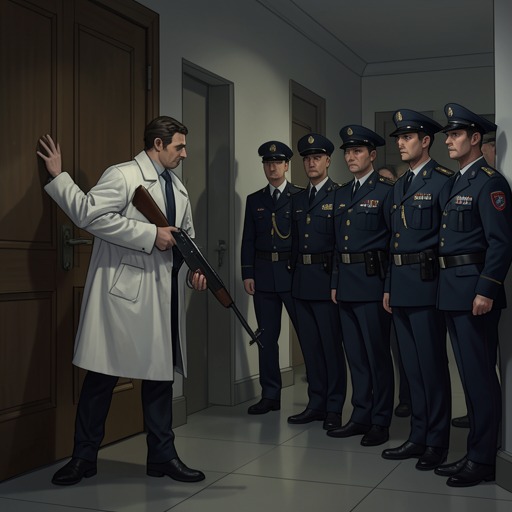
The evidence presents Hilarius as Oedipa’s psychiatrist, a figure she can approach with a question about whether her experience is fantasy. Yet their professional roles do not protect her from his crisis. When she returns to the clinic, Nurse Blamm tells her Hilarius believes someone is after him and has locked himself in his office with a wartime Gewehr 43. Blamm says that he has shot at half a dozen people. Oedipa notices that the nurse’s office window offers a safe route of retreat, and asks why Blamm did not run; Blamm replies that Hilarius might need someone. This exchange establishes the danger surrounding the clinic while showing that concern for the psychiatrist persists despite it.
Oedipa, too, remains in contact rather than treating the crisis as merely a clinical episode. At the office door, she tells Hilarius she came hoping he could talk her out of a fantasy. The request reverses the expected direction of therapeutic care: the patient brings her uncertainty to the doctor, but the doctor is now barricaded, armed, and unable to offer ordinary reassurance. Her question about what he did at Buchenwald makes their encounter an inquiry into the history behind the man who had occupied the role of interpreter and adviser.
The Buchenwald Revelation
Hilarius admits that he worked on experimentally induced insanity at Buchenwald. He describes experiments intended to render prisoners catatonic, carried out through varied methods including metronomes, staged scenes, drugs, hypnosis, and faces. He had been assigned to work with faces and recalls a subject named Zvi as a spectacular success. The revelation gives a concrete and morally grave history to the psychiatrist’s present claims of persecution; it also makes clear that his earlier professional identity rests alongside a past in which he participated in deliberate psychological torment.
Hilarius frames his later practice as penance. He says he tried to submit himself to Freud’s writings and to believe in their literal truth, despite what he regarded as their contradictions; he contrasts this choice with Jung. He describes trying to believe that a world shaped by Freud would leave no place for camps such as Buchenwald, and says he slept only three hours a night while attempting to sustain that faith. His account explains the terms in which he understands his own life, but it does not undo the actions he recounts. The gap between the atrocities and his effort to believe in a redemptive theory is central to the strain between doctor and patient: Oedipa receives a confession and an attempted justification, not evidence that the past has been repaired.
The Clinic Standoff
As sirens approach, Hilarius tells Oedipa that he does not trust the authorities or know where they would take him if he surrendered. He claims that he can make a face whose effects would be devastating to anyone who saw it, linking that claim to the earlier case of Zvi. The police break into the clinic, and Hilarius pulls Oedipa into his office and locks the door again. When she says that she is now a hostage, he answers with apparent surprise that it is her. The exchange briefly exposes how completely his fear has overtaken the professional bond: Oedipa is physically present in the crisis, but Hilarius seems not to have registered her presence in ordinary terms.
Oedipa’s response combines caution with continued engagement. She recognizes that she could not guarantee where the police would take Hilarius if he surrendered, but she also challenges his account by asking whether he thinks they have come to return him to Israel for trial and what he did at Buchenwald. After hearing his history, she invites the police to come in. Hilarius cries and asks whether she is going to shoot. The encounter ends the possibility of a normal therapeutic conversation: the psychiatrist has become the armed subject of a police confrontation, while his patient is left to decide how to respond to him in the moment.
Fantasy, Responsibility, and Separation
The relationship’s most consequential exchange occurs when Oedipa says that she came hoping Hilarius could talk her out of a fantasy. Rather than challenging the fantasy or testing it with her, he urges her to cherish it and hold it tightly, warning that losing it would make her begin to cease to be. The counsel is not a diagnosis of the Tristero’s reality. It is Hilarius’s own emphatic answer to Oedipa’s uncertainty, delivered while he is in the midst of a breakdown. Its emotional force therefore coexists with a serious limit: the psychiatrist whose judgment she sought cannot provide a reliable resolution to the question she brought him.
For Oedipa, the crisis belongs to a wider experience of losing people who might help orient her. Later, she thinks of her psychiatrist as pursued by Israelis and gone mad, alongside the increasing distance of Mucho Maas, the departure of Metzger, and the loss of Randolph Driblette as a guide back to the Tristero. She describes these men as being stripped away from her and asks where she is. This recollection makes the collapse of the therapeutic relationship part of a larger pattern of diminishing support, rather than an isolated clinic incident.
Significance to Oedipa’s Search
The relationship places Oedipa’s search for meaning beside Hilarius’s radically different relation to fantasy. She seeks an answer that might distinguish her suspicions from delusion; he urges her to preserve the very imaginative conviction she asks him to dispel. His advice may sustain her willingness to keep investigating, but the circumstances in which he gives it prevent it from functioning as a dependable confirmation of her theory. The episode thus sharpens the novel’s uncertainty: a person charged with interpreting mental experience reveals a history that complicates his authority, while his words offer emotional encouragement without settling what is real.
Hilarius’s crisis also changes the meaning of Oedipa’s care for him. She remains near the locked office, hears his confession, and faces him as police enter, even though she has reason to fear the situation and a practical route to retreat. That presence does not reconcile his past or return him to his role as a stable doctor. Instead, their connection ends in an encounter where professional dependence gives way to mutual exposure: Oedipa must confront the human being behind the psychiatrist, and Hilarius’s plea to preserve fantasy becomes one more voice in her unsettled effort to understand the world.